The Signs a Septic System Is Starting to Fail, in the Order You'll Actually Notice Them
Failure rarely arrives all at once. It shows up in stages, and knowing the order can save you the worst one.
August 26, 2026 · 4 min read
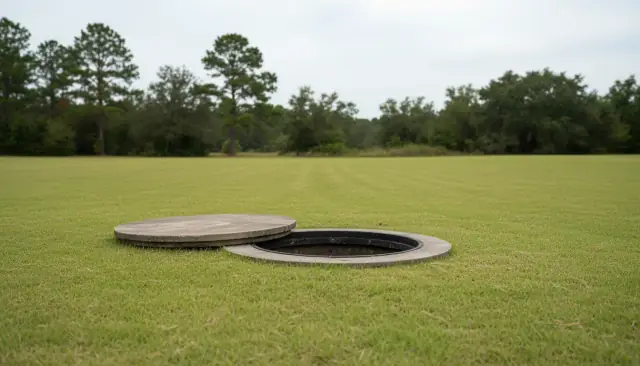
Nobody wakes up to a septic system that's completely fine one day and completely failed the next. There's almost always a run-up, a set of smaller warnings that most homeowners either miss or explain away, because each one on its own doesn't seem worth calling anybody about. Here's roughly the order they tend to show up in, from the earliest and easiest to fix to the one nobody wants to deal with.
Part of why these signs get missed is that they're easy to blame on something else. Slow drains get blamed on old pipes. A smell gets blamed on the trash cans sitting out. A wet patch gets blamed on a sprinkler head that must be leaking. Each of those explanations is possible on its own, which is exactly why it's worth stepping back and asking whether more than one of them is happening around the same time, because that pattern is the real tell.
Stage one: drains that are slow everywhere, not just one
A single slow drain is almost always a local clog, hair in the bathroom sink, grease in the kitchen line, something you can usually clear yourself. It's a different story when the shower, both bathroom sinks and the washing machine all start draining a little slower around the same time. That's not four separate clogs. That's usually the tank or the field line telling you it's getting harder to accept more water, and it's the earliest, cheapest stage to catch.
Stage two: gurgling that has nothing to do with what you're running
A gurgle when you flush is normal enough. A gurgle from the bathtub drain while the washing machine is running two rooms away is not. That sound is air trying to find somewhere to go because water isn't leaving the pipes the way it should. It's easy to ignore because it's just a noise, but it's the system working harder than it's supposed to, and it tends to show up a few weeks to a few months before anything more obvious.
Stage three: a patch of yard that won't quit
This is the one most people notice without realizing what they're looking at. There's a strip of grass over the drain field that stays soggy days after everyone else's yard has dried out, or it grows in a shade of green that doesn't match the rest of the lawn, almost too healthy looking. That's effluent surfacing closer to ground level than it should. It's tempting to assume it's just a low spot that holds water, and sometimes that's all it is, but if that patch lines up with where the field line runs, it deserves a second look before it turns into something worse.
Stage four: smell outside, even away from the tank
A faint sulfur smell right around the tank lid on a hot day isn't unusual. What's worth paying attention to is a smell that follows you across the yard, especially after rain, or one that shows up near the field line rather than the tank itself. Odor traveling away from where you'd expect it usually means gas or effluent is escaping somewhere it shouldn't, and it tends to arrive not long before the last stage on this list.
Stage five: backup inside the house
This is the last stage, not the first, and by the time it happens most of the earlier signs were already there. Water backing up into a tub or shower on the lowest level of the house, especially when other water is running elsewhere, means the system has nowhere left to put what it's being asked to handle. It's the most disruptive and expensive point to catch a problem, and almost always avoidable if any of the earlier stages had gotten a call instead of a shrug.
The gap between stage one and stage five isn't fixed. Sometimes it's months, sometimes it's a couple of years, depending on the household and how the system was doing before the first sign showed up. What doesn't change is the direction. Once a system starts down this list, it doesn't fix itself by waiting, and every stage skipped past is one more sign that got explained away instead of checked.
- Multiple drains running slow at the same time, not just one
- Gurgling unrelated to what's currently being flushed or run
- A wet or unusually green patch over the field line
- Smell that travels beyond the tank area, particularly after rain
- Backup indoors, which is the final stage, not an early one
None of these mean the tank needs replacing. Most of the time they mean it's due for pumping, or a line needs a look, and catching it at stage one or two is a very different bill than catching it at stage five. Gulf Coast Septic answers the phone 24 hours Monday through Friday and Saturday 8:00 AM to 5:00 PM, offers free estimates, and has been family owned and operated on the coast for more than forty years, licensed, bonded and insured. Call (228) 872-4449 if any of this sounds familiar.
Gulf Coast Septic, (228) 872-4449
Call (228) 872-4449More articles
How Often Does a Septic Tank Actually Need Pumping on the Gulf Coast?
The three-to-five-year rule is a decent starting point, but what's happening inside your house changes the real number.
Nobody Knows Where the Septic Tank Is. Now What?
It happens more than homeowners think, and it's a lot less dramatic to fix than it sounds.